Hey folks!
I finally finished running Stolen Fate, so I figured I should compile all those posts into one place! I'll also briefly comment on each chapter that I didn't remix or change, and include links to other resources I found on the internet.

Hey folks!
I finally finished running Stolen Fate, so I figured I should compile all those posts into one place! I'll also briefly comment on each chapter that I didn't remix or change, and include links to other resources I found on the internet.
Hey folks! Sorry for the delay on this, real life got in the way (see my previous post for brief details).
In this series so far, we talked about what Scenario Structures are, Pathfinder's Non-Scenario Subsystems, its Infiltration Subsystem (which is IMO the system's best example of Scenario Structure), and the Other Scenario Structures that Pathfinder 2e has.
Today's post will start relatively short, but it will be a living post, and I may come back and update it with other structures or resources. We'll talk about what Scenario Structures need and what things to consider when running them, briefly discuss Scenario Structures from other games that can be stolen without too much work, and we'll keep a running list of PF2 Scenario Structures as well as resources that might help folks design their own.
Lets jump in!
Hey folks!
To anyone following along my series on Scenario Structure, sorry for the delay! I'm almost done with Part 5, and have a couple partial drafts of new Scenario Structures, but unfortunately one of my games had a bit of an interpersonal blow up that led to a player leaving (ultimately for the best I think, but a bummer the way it went down). Dealing with this ate up a bunch of my time for side-projects, and that paired with all three of my campaigns entering new arcs (SoT is just about to start the final chapter; I finished SF with my partner and we are moving onto Rusthenge/7 Dooms; RHoD is about to head to the Hammerfist Holds) means that I am mostly focusing on content for my immediate games, at least for the time being.
Along those lines, today, we'll be writing up some visions! Specifically, I am planning on probably running a converted/edited Alexandrian Remix of Descent Into Avernus after the Red Hand of Doom, and want to seed as many elements from Elturel in Brindol as possible to help keep up the feeling of continuity. One of the coolest parts of the remix are the memory dives, including the Vision from Torm. My players never made it to Cinder Hill, and therefore haven't seen Azarr Kul, nor do they directly know that Tiamat is involved. Today, I'll be pulling all these threads together and creating a vision that the Helm of Iomedae's Sight might give to a member of the party as they enter the final stages of the war.
Let's jump in!
 |
| The Ring Goes South to Mordor |
In our last article, we talked about what I consider to be the best example of Scenario Structure in PF2 - the Infiltration Subsystem. We talked about its strengths, how it's used in adventures, and what changes or variations might be worth making.
Today, unfortunately, we're going to be a bit more negative. We're going to be talking about Pathfinder 2e's other Scenario Structures, or, in many cases, the lack thereof. We'll start by talking about the other "official" Scenario Structure - Hexploration (yes, this is the only other "official" one) - before going into the less defined structures. This includes Investigations (essentially several Research libraries stapled together in Gatewalkers), Dungeon Crawls (which do not have explicit rules in PF2), Linear Sequences (where things just happen in a given order), and various less detailed structures in APs. We generally won't be going into quite as much detail for each of them, but there's a solid chance I'll remake some or all of them in Part 5.
We've got a lot to get through, so let's jump on in!
 |
| Source |
Today, we'll be talking about the Infiltration Subsystem, which is in my opinion Pathfinder 2e's best example of a Scenario Structure.
Let's jump right in!
Hey folks!
 |
| by Satibalzane on Deviant Art |
Part 1 hogged all the intro space, so we're gonna keep this intro short. Let's jump in!
Somethings been rattling around in my head for a long time.
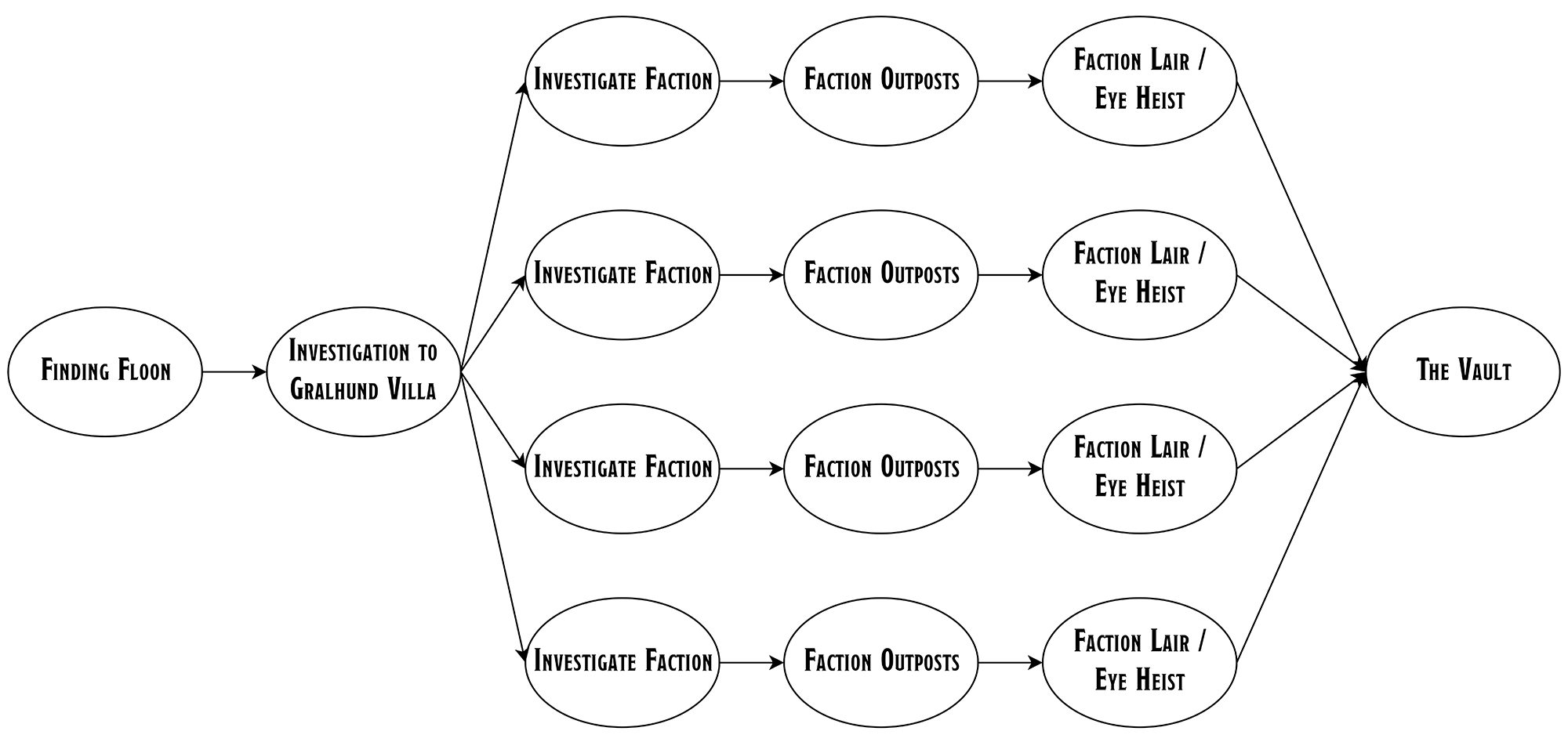 |
| The core structure of the Alexandrian Dragon Heist Remix |
I've been running RPGs for about a decade now. I started with 5e when it was pretty new, had a good time, and slowly became disenfranchised with its myriad problems. Along the way I found a lot of great advice, especially from Matt Colville and The Alexandrian, but for a long time I mostly ran either published modules or homebrew adventures that were in a similar style.
When I switched to Pathfinder 2e in 2020, I didn't really have problems with the rules themselves. There are still things that don't quite match my preferences, and certain things that I'd probably have done differently, but for the most part the system just works. If I'm too tired to make a call, the game has me covered. I don't have to worry about PCs accidentally becoming overpowered or trivializing an encounters due to a broken rules interaction. And if I do have the energy to make a call that's outside-the-box, or the players come up with an idea clever enough that I want to let them trivialize an encounter, I always have the freedom to do so.
With less work to do hammering the rules into place, however, I could focus more on the adventures themselves. My first real project on this blog was Remixing Strength of Thousands Book 2 in the style of the Dragon Heist Remix, where I deconstructed the grab bag of random quests and put them back together into a more cohesive whole. To date, it's my second most popular series after my Red Hand of Doom Conversion. Ever since, most of my blog has been doing the same - tinkering with adventures to make them more fun to run and play - but the series that finally crystalized my main point today was the one about Negotiations in Mzali.
Now, you might say, "Why do you need to tinker with Pathfinder 2e Adventure Paths? They are so much better than 5e adventures!" And that's true! Genuinely! I love APs, but they still often have problems of their own. Probably the most common complaint about them is about how over-complicated a lot of subsystems are, and I think that is often true! If you've been following this blog for a while, however, you might guess that to me those are just symptoms of a larger issue: structure.
This series is about Scenario Structures: what they are, why they're important, and why Pathfinder 2e would benefit from more of a focus on them. That's right, I said series - as you might be able to tell from the length of that intro, this is a topic I've thought a lot about, and it's gotten a bit away from me. Here's my plan for this series (I'll update it as things develop):
Let's jump into Part 1!
 |
| I wish our Bugzilla was this cute... |
My group is gearing up for the epic finale of Strength of Thousands, and I'm super excited! I love the concept of a massive larva breaking free, wrecking havoc on the place the PCs have spent the last several years (both in-game - for my group, it's been about 7 years - and out-of-game - we've been playing for almost 4 years!), and the final ritual is a really appropriate finale to a magic school AP.
Perhaps my favorite thing about this chapter is the "Coming Late" section of the three encounters under "The Larva Spawns" - making the choice of what order to do these in matter is amazing design, 10/10. Unfortunately, this design doesn't extend to the rest of the chapter, and the PCs have effectively limitless time to complete the other encounters with no consequences for wasting time!
My least favorite thing, however, is just how many combats there are. It's kind of overwhelming! Most of them are low or trivial threat, which is great for making the PCs feel baddass but bad for giving enough XP to fill out a chapter (IMO less important in the finale where they're already level 20, but the design intent is clear). So, there's a ton of them!
In this post, I aim to address both of those in one fell swoop! Essentially, the PCs will have limited time. Prioritizing some fights over others might gain them allies that they can dispatch to solve those situations for them! And for every situation the PCs don't successfully resolve in time, the final waves of enemies get harder as there are fewer allies in other areas to draw them away.
Hey folks!
 |
| From Shadowdark RPG |
This is a weird one, because it's part 5a of a series for which I have not yet published part 1 - the overall series is about what I see as a need for more thoroughly fleshed out Scenario Structures in Pathfinder 2e. I have part 1 about 90% done, and the other parts are well under way as well, but I decided to go ahead and publish this one first because I think folks might find it useful! (Note: I have now finished it! See link above.)
Today, we'll be outlining a core dungeon procedure for PF2 that aims to fit as neatly into PF2 as possible without changing any rules. Ideally, it should work even if you implement it in an existing AP without doing a whole bunch of extra work. I'll also include some extra credit for if you do want to put in the work, or you want to change more about how you run dungeons.
Let's jump in!
Dwarves! Everyone loves Dwarves... unless they're on the receiving end of their mighty axes! The Red Hand therefore did everything it could to keep those axes FAR away...
This post includes three things across two documents. First, basic details about the Hammerfist Holds. Second, some miscellaneous sidequests and sandbox/travel details. Third, and most importantly, the case of the Absent Clanlord, which the PCs must navigate in order to gain Dwarven allies for Brindol's defense!


